I. Market Overview
Market Size:
The Chinese market reached RMB 12 billion in 2023 and is projected to exceed RMB 18 billion by 2025, with a CAGR of 14.5%.
The global market is projected to reach approximately USD 13.58 billion in 2024, with a projected CAGR of 7.85%.
The facial recognition terminal market reached RMB 6.87 billion in 2024, accounting for 66.06% of the industry.
Growth Drivers:
Accelerated smart city construction (investment exceeding RMB 2.8 trillion, terminal share 18%)
Digital transformation of government services (coverage exceeding 85% of county-level and above service halls)
Explosive demand for intelligent upgrades in industries such as healthcare and retail
II. Technological Development Trends
1. Hardware Upgrades
Display Technology: Developing towards 8K ultra-high definition, flexible screens (foldable screens will account for 18% by 2025), and Mini LED backlighting (penetration rate 35%)
Recognition Technology:
3D structured light + ToF technology (accuracy reaching...) 1. 0.1mm aperture, 99.9% recognition rate:Penetration rate reaches 47% in high-end fields such as finance and military. Features include: Binocular liveness detection for anti-spoofing, recognition time ≤0.3 seconds, adaptable to strong backlighting scenarios.
Interaction Upgrade: Multi-touch accuracy error <±0.5mm, response time<8ms, supports 2048 levels of pressure sensitivity.
2. Software and System Innovation:
AI Fusion: Face recognition accuracy improved to 99.3%-99.9%, false recognition rate reduced to 0.0001%.
Emotional Computing: Recognizes 200+ micro-expressions, adjusts interaction strategies in real time.
Edge Computing: Local processing latency<50ms, supports offline recognition, device penetration exceeds 65%.
Multimodal Interaction: Fusion of "touch + voice + face + gesture," 90% of devices will support it by 2025.
3. Architectural Evolution: "Cloud - Edge - Device" Collaboration:
Cloud: Unified data analysis, generating operational suggestions
Edge: Localized AI enables real-time early warning
Terminal: Intelligent interaction, linking with robots, drones, and other devices
5G+IoT Integration: By 2025, over 90% of devices will support 5G, and the IoT access rate will reach 90%.
III. Industry Application Panorama
1. Government Services (35.6%)
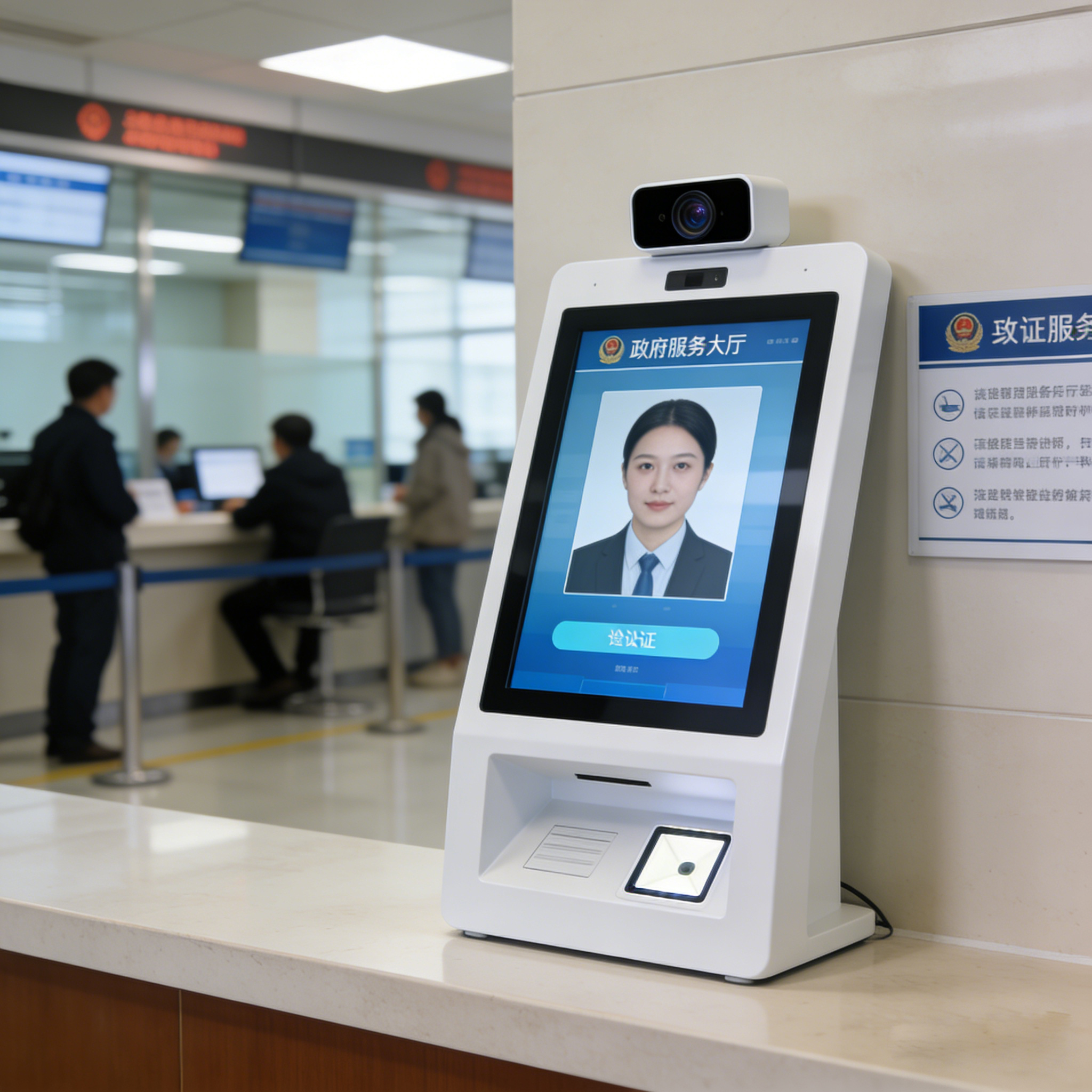
Government Service Halls: Full coverage of self-service terminals, serving 200+ people per day per terminal
Smart Government: Facial recognition + automatic document filling, reducing approval time by 70%
Immigration and Exit: Self-service border inspection system, reducing clearance time by 60%+
2. Healthcare (28.3% growth)
Medical Process: Fully self-service registration, payment, and report printing, with over 90% penetration in tertiary hospitals
Pre-examination and Triage: Facial recognition + temperature detection, completing over 20,000 health code verifications daily
Telemedicine: Touchscreen supports surgical guidance, improving treatment outcomes 30%
Smart Pharmacy: Facial recognition for medication dispensing, 100% accuracy, 50% reduction in waiting time
3. Education Industry (Growth Rate 15%)
Campus Management:
Attendance + Exam Check-in: Eliminates proxy check-in, 99.9% accuracy
Digital Class Signs: Real-time display of courses and notifications, parents can remotely participate in "cloud parent meetings"
Practical Training: 23% year-on-year increase in devices larger than 85 inches, supporting immersive teaching
4. Retail and Commerce (19.8%)
Smart Stores:
Facial Recognition Payment: Transaction time reduced to 2 seconds, average order value increased by 18%
Member Recognition: Precise recommendations, conversion rate increased by 30%+
Unmanned Retail: Self-service checkout penetration rate 65%+, 8-12 interactive screens deployed per store
Catering: Intelligent ordering system, customer ordering efficiency increased by 40%, Haidilao added 8000 units annually
5. Transportation
Airline: Full-process facial recognition access (check-in, security check, boarding), reducing time by 60%+
Rail Transit:
Subway: Facial recognition entry: Beijing's 172 stations handle an average of 8 million passengers daily
High-speed Rail: 100% coverage of real-name verification terminals, ticket verification time < 1 second
Parking: Seamless access, payment efficiency improved by 50%, passage time < 2 seconds
6. Industrial Manufacturing (Growth Rate 30%)
Production Management:
Worker attendance + access control, replacing traditional card swiping, improving efficiency by 70%
MES System Terminals: 47% penetration in the automotive manufacturing sector, real-time monitoring of production lines
Quality Inspection: AI visual inspection, defect recognition rate 99.4%, replacing manual labor
Smart Warehousing: 3D facial recognition positioning, picking efficiency improved by 40%
7. Other Fields
Community Security: Facial recognition access control + blacklist alerts, automatic alarms for abnormal personnel
Smart Office: Meeting room reservation and check-in, smart locker management, improving… 30% Increased Office Efficiency
Smart Hotels: Facial recognition check-in, check-in time < 30 seconds, saving 50% on front desk staff
Smart Agriculture: Greenhouse environment monitoring + personnel management, increasing production efficiency by 25%

 Español
 Portugues
 Pусский
 Français
 한국어
한국어 العربية
 中文
中文